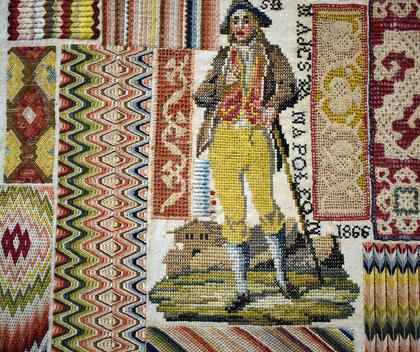
Embroidery samplers were an integral part of a woman’s education in early modern Europe and the Americas. Girls practiced their needlework, copying geometric patterns, floral motifs, and lettering from printed design books and other works of embroidery. In the 1940s, the Allen received an important gift of Mexican embroidery samplers with an imperial provenance. These samplers were produced by Mexican girls living in Oaxaca, Puebla, and Jalisco. During a period of political upheaval and colonization in Mexico, these embroidery samplers were gifted to the Austrian-born ruler Maximilian I, who was Emperor of Mexico between 1864 and 1867. Maximilian and his wife Empress Carlota treasured these embroidery samplers—displaying them prominently in the imperial palace of Chapultepec. When Maximilian’s reign was overthrown, and President Benito Juarez was restored to power, many of the artworks in Chapultepec were destroyed; however, the samplers in the Allen’s collection were miraculously spared. This exhibition explores the intricacies of early modern embroidery work, highlighting how 19th-century Mexican embroidery samplers combined aspects of both European and American stitch techniques with iconography and patterns that have origins in indigenous Aztec visual culture. The intricate beadwork, embroidered ornamentation, and vibrant patterns visualize interwoven threads of adaptation and resistance in women’s education in colonial Mexico.